Friday, October 3, 2014

Poke Milkweed

Poke Milkweed
Asclepias exaltata
Poke Milkweed doesn't follow the rules for milkweeds; open sun and dense inflorescence. Instead, it grows in the woods and has a loose inflorescence that hangs downwards. The only giveaway is the individual flower structure with the five petals that point backwards and the five "hoods" that point upwards (downwards in this case).

This flower structure is highly developed to aid in pollination. Rather than explain it here, there are several references on the internet with detailed explanations, for instance here and here. You'll find it amazing to see the intricate design of this flower in order for it to successfully cross-pollinate.


Thursday, October 2, 2014

Common Bladderwort

Common Bladderwort
Utricularia macrorhiza
Common Bladderwort is a carnivorous plant without leaves or roots and floats on the water. It is a very peculiar plant. The underwater bladders are traps that capture small animals; water fleas, nematodes, mosquito larvae (yay!), and even fish fry and small tadpoles.

The trap is set by creating a negative pressure within the bladder in comparison to the surrounding water. The trap door has trigger hairs that are tiny little levers that hold it closed. When the prey brushes against it, the trigger hairs move and the trap springs open, which sucks in the water and the prey, then the trap door closes; all within 15 milliseconds.

The plant bladder pumps water out of the bladder via a mechanism called Active Transport, which you can read all about in Wikipedia. This basically pushes water out of the bladder via the membrane, thus causing the negative pressure, which allows the trap to be set. All very cool!

This is one plant that engineers could get excited about!

Wednesday, October 1, 2014

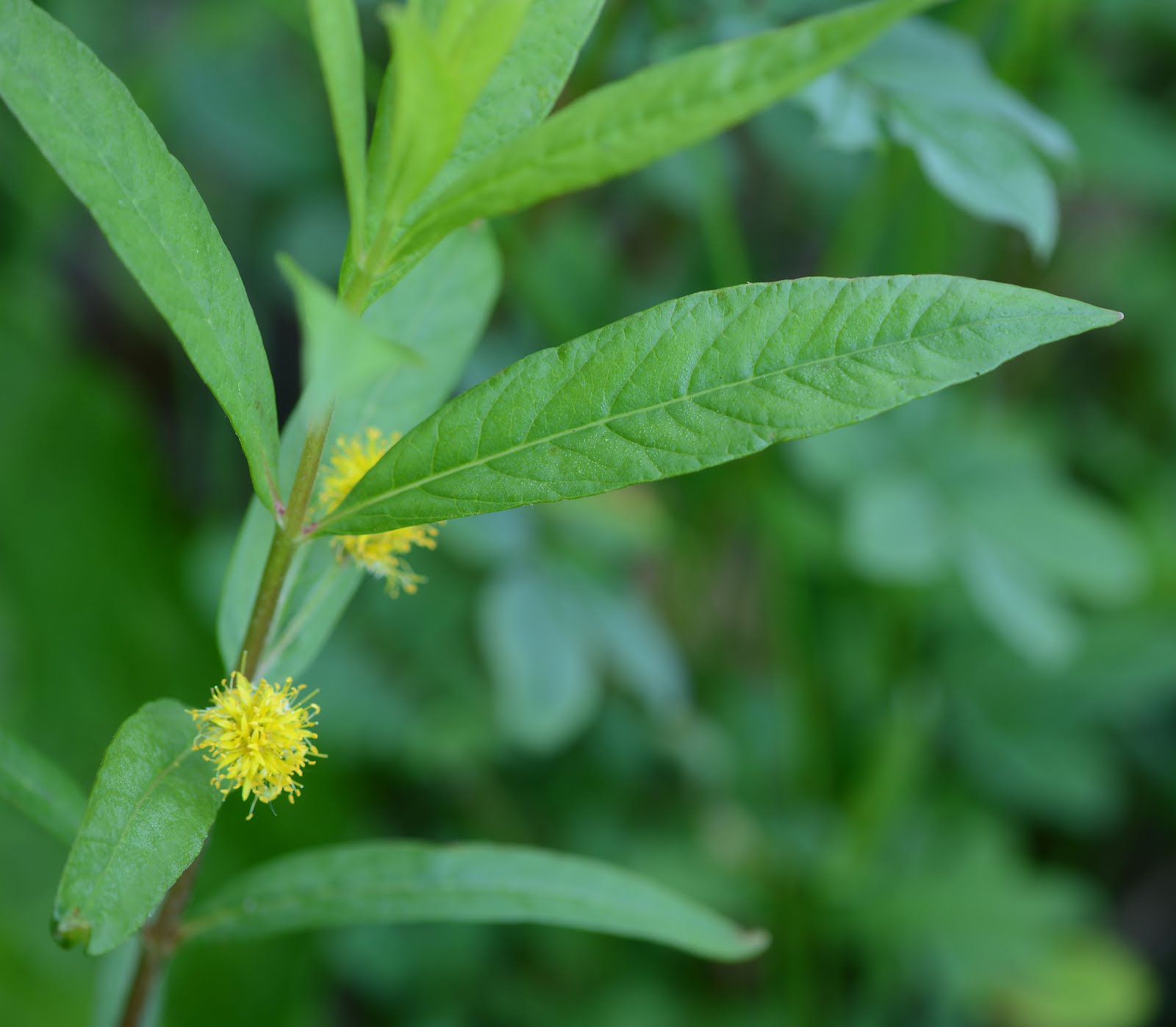
Tufted Loosestrife

Tufted Loosestrife
Lysimachia thyrsiflora
This is an interesting plant. It has a circumpolar distribution, yet is rather uncommon anywhere it's found. It's an obligate wetland plant, which means that it is only found in wet soils. This all suggests that it has been around for a very long time, either so long ago that the continents were still connected, or else long enough for them to disperse all around the northern part of the world.

It is found across the northern part of North America and across the north part of Indiana. I've only seen it in one place, along a lake edge. I suppose some of the rarity is due to the fact that it grows in a difficult place to get to and therefore is more rarely seen.

It's a striking plant to come across, just walking along a boardwalk in mid-summer and the yellow tufts of flowers jump out a you. The flowers don't stick up over the foliage, but rather hide below it. I guess there are more pollinators hanging around under the foliage that up over it.